Why Drywall Behaves the Way It Does When It Gets Wet
Drywall is gypsum sandwiched between two layers of paper, and both of those materials love water in different ways. The paper face wicks moisture upward like a paper towel dipped in a glass, which is why you often see a tide line several inches above where the actual flood stopped. The gypsum core, meanwhile, absorbs water and loses its structural integrity, going soft and crumbly in ways that paint and primer can hide for weeks. Combine those two behaviors with the warm cavity behind the wall and you have the perfect environment for mold colonization, which is why the IICRC 48 hour window matters so much. You can read more about that in our overview of how fast mold grows after water damage, but the short version is that wet drywall left alone past two days is no longer a drying problem, it is a remediation problem.
The category of water matters just as much as the duration. Clean water from a supply line is the most forgiving, gray water from a dishwasher or washing machine is in the middle, and Category 3 water from a sewer backup or storm surge has a completely different ruleset. With Category 1 water caught quickly, your drywall often stays. With Category 3, the affected drywall comes out, full stop, because the contamination soaks into the porous gypsum and cannot be cleaned in place. It is also worth understanding that the age of the drywall plays a role. Older sheets from the 1970s and 1980s were sometimes manufactured with denser cores that hold moisture longer, while modern lightweight gypsum can fail structurally at lower saturation levels. Neither version is better or worse for drying, they just behave differently under a meter, and an experienced technician will adjust the drying plan based on what is actually in your wall rather than assuming all drywall is the same.
The Flood Cut, and Why We Do Not Always Make One
You may have heard the term flood cut, which refers to removing drywall in a straight horizontal line, usually somewhere between 12 and 24 inches above the floor. The cut height is not arbitrary. We measure the actual moisture migration with a penetrating meter, find where the readings return to the dry standard for your wall assembly, then cut several inches above that boundary to give ourselves a clean margin. On a Category 1 loss caught within a few hours, we often skip the flood cut entirely and dry the wall in place by removing the baseboard, drilling small ventilation holes behind where the baseboard will sit, and pushing warm dry air into the cavity with directed air movers. That approach preserves your paint, your texture, and your trim, and it shortens the timeline for getting your home back to normal.
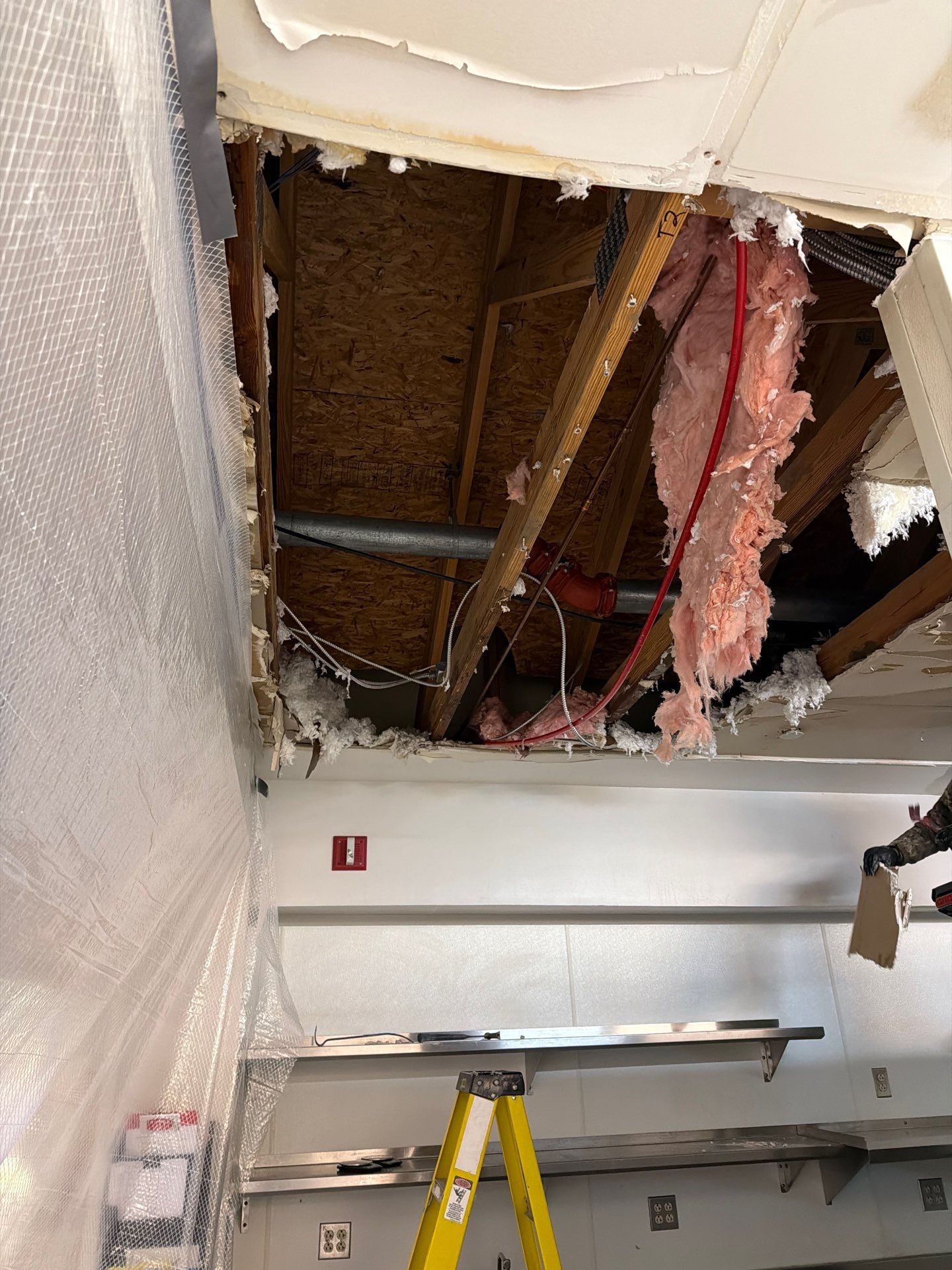
When the water has been sitting longer, when insulation is involved, or when the category steps up to two or three, the calculation changes. Wet fiberglass insulation behind drywall almost always means the drywall comes out, because there is no practical way to dry batt insulation in place without removing the wall covering. Blown cellulose is worse, since it clumps when wet and stays damp for weeks. In these cases the flood cut is not optional, and we will often go higher than the visible damage line to make sure we remove every inch of compromised material. The same principle applies to ceilings under a second floor leak, where gravity and saturation can drop a section without warning. Our blog on water damage behind walls goes deeper into the detection side of this work.
What Stays, What Goes, and How We Decide
The decision tree we run in your home looks at four things in order. First, what category of water are we dealing with, because Category 3 forces removal regardless of how the drywall looks. Second, how saturated is the gypsum core, which we test with both surface and penetrating meters at multiple points along the affected wall. Third, is there insulation in the cavity, and if so, what kind. Fourth, how long has the moisture been present, because past 48 to 72 hours the mold conversation overrides the drying conversation.
Walls that pass all four checks get dried in place, monitored daily with documented moisture readings, and signed off only when the gypsum returns to the equilibrium moisture content for your region. Walls that fail any one check get cut, with the cut line documented in photos before, during, and after so your insurance carrier has a complete record. We dispatch crews in most cases within 2 hours of your call, and we bring the same documentation discipline whether the loss is a small bathroom supply line or a fully flooded basement with three rooms of saturated wall.
One thing we will not do is open more wall than the moisture data supports just to make a job look bigger on the invoice. We will also not leave a wall closed up because the homeowner is hoping for the best, when our meters are telling us the gypsum behind it is at 40 percent moisture content and climbing. Honest scope is the whole point of having an IICRC certification on the truck, and it is the standard Yellowwood Water Restoration holds every technician to on every Yellowwood job.
What Happens After the Cut
Removing drywall is only the first half of the project. Once the wet material is out, the cavity itself has to be dried and verified before any new sheet goes up. That means running air movers and dehumidifiers aimed into the open studs, monitoring framing moisture content daily, and treating exposed wood with an antimicrobial if the loss involved gray or black water. Studs and bottom plates that read above 16 percent moisture are not ready for new drywall, regardless of how dry the surface feels to the touch. Closing a wall too early traps residual moisture against fresh paper, and the mold problem you avoided by cutting comes back six months later behind brand new paint.
The reconstruction phase is where homeowners often see the value of having one company handle the full process. When the same team that documented the original moisture readings hangs the replacement drywall, tapes the seams, and matches the texture, nothing falls through the cracks between trades. In Yellowwood, Yellowwood Water Restoration keeps mitigation and rebuild under one roof so the handoff is internal, the insurance file stays consistent, and you are not chasing three separate contractors to finish what started as a single leak. That continuity is, in the end, what separates a clean recovery from a job that drags on for months.